Picture this: you’ve spent hours preparing for an executive presentation. Thirty seconds in, someone interrupts you. Your instinct says it’s going sideways. It’s probably not. I’ve been collecting insights from leaders who’ve sat on both sides of the table, and one thing keeps coming up: understanding how executives think is one of those unwritten corporate rules nobody hands you a guide for. You learn it the hard way, or you get lucky and someone clues you in. Here are a few insights worth keeping in your back pocket the next time you’re in that room.
If you’ve ever had the opportunity to present to an executive leader or been unexpectedly pulled into a conversation with a group of executives, you know that feeling. Your heart rate ticks up just a little. You start scrubbing your slides. You wonder if you’re going to have the right level of information.
After years of working in corporate environments, most of that anxiety comes from misreading what executives actually need from you in those moments.
They’re not there to evaluate your intelligence or judge your presentation skills. They’re there to make informed decisions and they need you to help them do that efficiently. One of my CMO mentors at Microsoft once told me “I just wish people would tell me what they wanted from me instead of making me wonder throughout the presentation.”
So let’s talk about how to show up ready.
What Executives Are Actually Looking For
Kevin Goldsmith, a CTO with decades of experience on both sides of the conference table, offers a helpful perspective in this LinkedIn post that reframes the whole dynamic. Think about it this way. Executives are often in back-to-back meetings for eight hours a day. They’re counting on subject matter experts like you to help them reduce risk, gain alignment, and understand implications. The clearer you make that for them, the more they’ll appreciate having you in the room.
His framework (the Four C’s) is a simple but powerful checklist to run through before any executive conversation:
Clarity: Are you using language that is clear and can’t be misinterpreted?
Context: Have you connected your topic to the broader business picture, not just your team’s corner of it?
Consequence: Have you made it clear what happens if action is taken or not?
Control: Are you demonstrating genuine command of your subject, including the risks and trade-offs?
If you skip even one of these, expect the conversation to take a detour while the executive hunts for the missing piece. They’re constantly scanning for risk, alignment, and implications…even when it may not look that way from where you’re standing.
A few things worth keeping in mind:
Plan to use about half your allotted time. Interruptions aren’t a bad sign, they’re part of the process. When an executive stops you to go deep on something you considered minor, that’s not a derailment. That is the meeting.
Lead with the conclusion. In emails or reports, don’t make executives read through all the background to find your point. If you have heard “don’t bury the lead” that’s essentially a signal to state the key point or conclusion first, then provide context for those who want it.
Don’t protect your ego, protect your credibility. If you don’t know the answer to a question, say so. “I don’t have that information, but I’ll get it to you by end of day” lands far better than a guess that gets fact-checked in someone else’s meeting.
Phrases That Quietly Erode Your Executive Presence
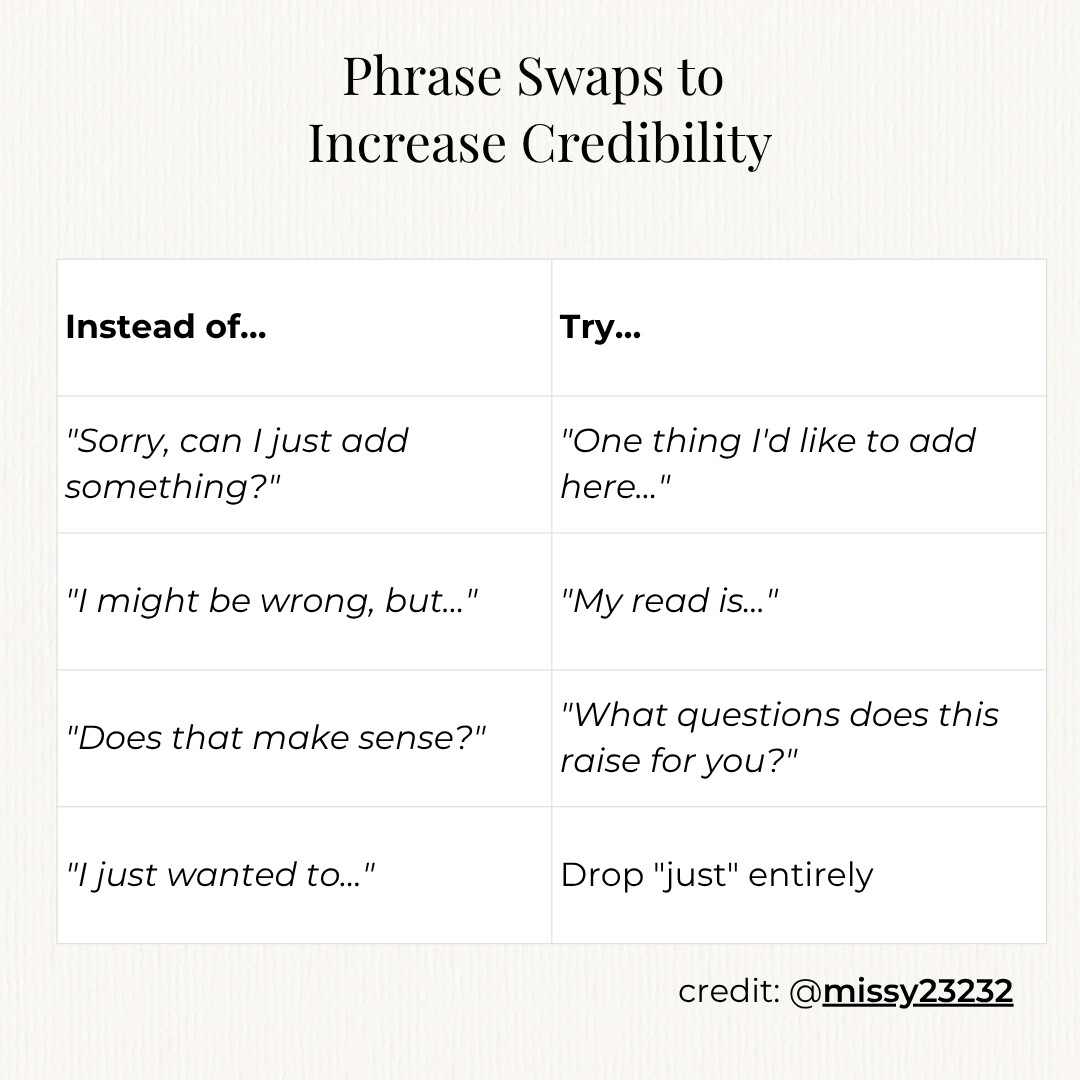
Career coach Melissa Marcus made an important point in a recent Instagram post: when speaking to executives, there are certain phrases that may be quietly eroding your credibility especially if repeated over many months.
Watch out for these four and try the swaps instead:
Why These Phrases are Problematic
Melissa explains what these phrases might be signaling and offers suggested swaps.
“Sorry, can I just add something?” It’s easy to default to apologizing, especially in high-stakes rooms. But this phrase can unintentionally signal that you don’t quite deserve to be heard before you’ve even made your point. → Try instead: “One thing I’d like to add here…”
“I might be wrong, but…” You’re pre-discounting everything that’s about to come out of your mouth. If you don’t sound like you believe it, neither will the room. → Try instead: “My read is…”
“Does that make sense?” This one makes it sound like you’re asking the room to validate your credibility rather than inviting real conversation. It signals uncertainty, even when you don’t feel it. → Try instead: “What questions does this raise for you?”
“I just wanted to…” “Just” is a filler word that softens and shrinks your message. It makes a confident statement sound like an apology. → Drop “just” entirely.
A great way to catch yourself? Record your next team meeting and listen back for these phrases. Most of us don’t realize how often we use them until we hear them out loud.
The Mindset Shift That Changes Everything
Here’s the reframe that I think matters most: you are not in that room to display your expertise. You’re assumed to have it and that’s why you were invited. You are there to help executives make good, informed decisions.
As Goldsmith puts it, ask yourself before your next executive meeting: Am I optimizing to be right, or am I optimizing to be understood?
That single question can change everything about how you show up.
Have you ever had a high-stakes executive conversation that went better (or differently) than expected? I’d love to hear about it in the comments below!
Thanks for reading and sharing! xx