If you’ve ever walked out of a meeting having identified every problem on the table but no clear path forward, this one’s for you. In this post, I share a method for becoming the person who doesn’t just see the obstacles, but actually knows what to do about them.

Last week, I shared one of the concepts from the 10 week beta program I participated in on advanced communication techniques. It was all about the stories we tell ourselves under pressure and how to interrupt unhelpful loops.
Today’s post builds on that. Because once you’ve got a handle on the stories in your head, the next challenge is what you actually do when a problem is burning right in front of you.
While problems are usually opportunities in disguise, they don’t always feel great in the moment. Especially when they are visible, complex and have flames or fire emojis associated with it. As much as it’s fun to jump onboard with others who are admiring the problem, it’s much better to be seen as a “solution seeker.” Who is a solution seeker you ask? In it’s simplest form…it’s the person in the room who moves the conversation from complaint to action.
Why Being the “Problem Person” Is a Career Risk
To be clear, I personally don’t think identifying problems is a bad thing. It means you’ve noted something in the way of reaching a desired outcome. The thing to be careful of is when you’re consistently the one pointing out what’s broken without advancing toward a solution. It might be sending a signal you probably don’t intend (creating a reputation for surfacing friction rather than resolving it). It can even reduce your influence because people stop inviting the person who only brings problems to the table. (Nobody wants to be that person. We all know that person!)
The problems are real. You’re not wrong to see them. But the skill that separates good contributors from influential leaders is the ability to move through the problem, not just name it.
The Sticky Trap: The Drama Triangle
When we’re stuck in a problem, especially a big or a recurring one, we start to relate to it emotionally. We might feel discouraged, disappointed, or disempowered. And when we feel that way, we often go into cope mode. The risk is that our default coping strategies often keep us stuck. (The irony of coping your way deeper into the problem is not lost on anyone.)
The framework used to describe this is called the Dreaded Drama Triangle, and it captures three ways we tend to react under pressure.
- The Rescuer over-indexes, takes on everyone else’s work, and exhausts themselves trying to fix everything.
- The Persecutor: gets controlling and rigid, shutting down collaboration in the process.
- The Victim: feels powerless, convinced that the budget, the boss, or the system is the reason nothing can change.
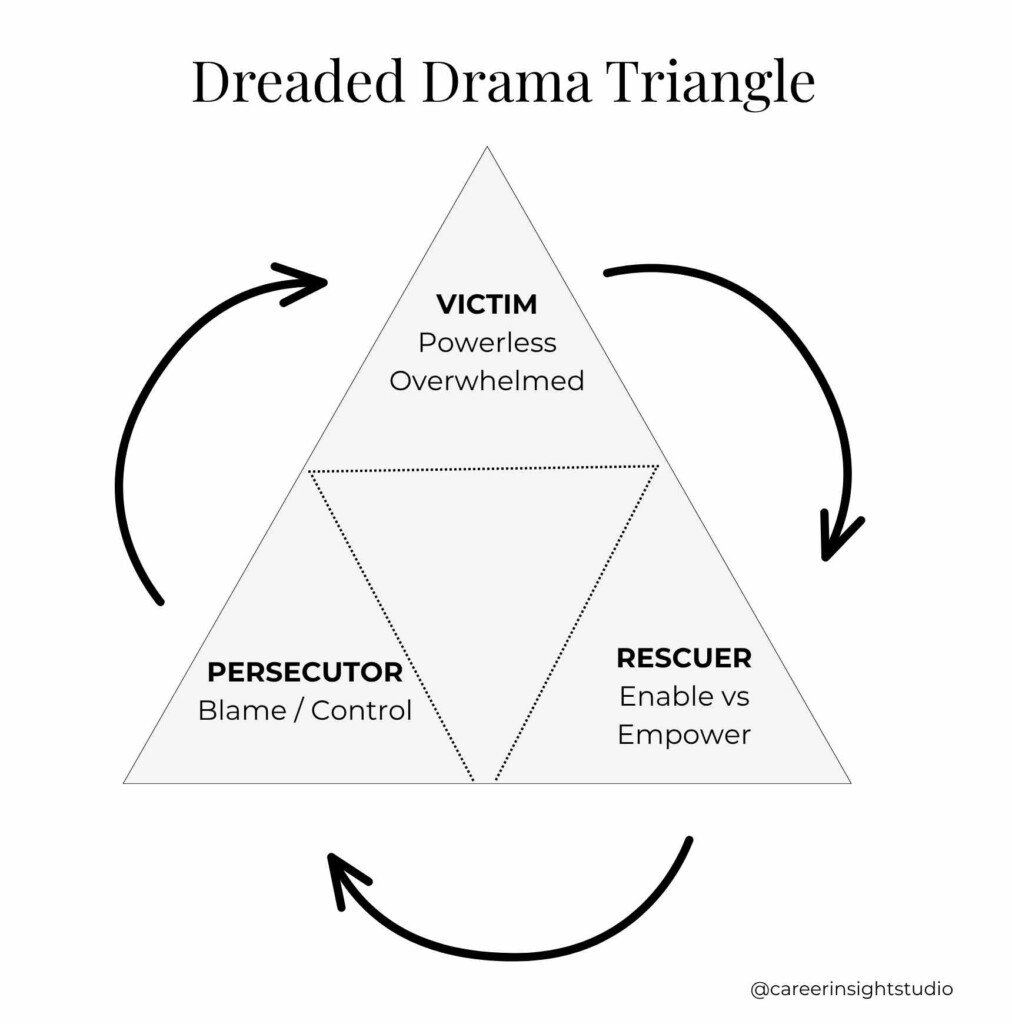
None of these are permanent personality types. They’re just reactive patterns that show up situationally, and most of us have rotated through all three at different points. They keep us circling the problem instead of moving toward a solution. (And the circle, as it turns out, is exhausting.)
The way out is simpler than you’d expect: shift your focus from the problem to the desired outcome. When you can focus on what you want instead of what’s going wrong, you reclaim your ability to think and act clearly.
Three Questions To Move You Forward
Question 1: What’s My State?
This is a personal check-in before anything else. Ask yourself “Am I feeling so frustrated or discouraged that I can barely think straight? If yes, that’s your sign to take a beat. You can’t think your way to a solution from inside the swirl. Getting grounded first isn’t a detour; it’s the fastest path forward.
Reflection: Before you engage, take a beat. Ask yourself honestly — am I approaching this from a grounded place, or am I still in reactive mode?
(Or you can always think about Ice Cube who said it best back in the 90’s: “check yourself before you wreck yourself.” The work version is a little more subtle, but the principle is the same.)😉
Question 2: What’s My Story?
This is the moment to do a quick mindset check. A common trait that solution seekers do is take responsibility for the problem and put themselves in the right frame of mind: This is mine to solve. I can move forward with incomplete data. Complexity is the enemy, keep it simple. Test fast, learn fast, fail fast. Stay calm and carry on. If any of those feel like a stretch, that gap is worth paying attention to.
Reflection: Which of these mindsets do you need to get clarity, and what does defaulting to the opposite cost you at work?
Question 3: What’s My Strategy?
Now you’re ready to actually solve something. Here are four steps to get there:
Define the real problem. Not the symptom but try to get to the root cause. What’s actually broken? What would happen if you did nothing? Leaders put effort in to address the source, not just the surface. Even better if you can leverage data to clarify the problem so it’s objective, not personal.
Establish the desired outcome. Before generating ideas, get clear on what success looks like. If you’re working across teams, find the outcome everyone shares and focus there.
Identify constraints and non-negotiables. What are the real limits? Getting honest about what can’t change focuses your energy where it can actually do something.
Generate options. Coming in with one solution is better than coming in with only the problem. Coming in with two or three options and a clear recommendation is what builds credibility at the executive level. Lay out the tradeoffs and make your recommendation.
Reflection: What’s the root cause of a problem you’re currently facing, not just the symptom? And what outcome would all involved stakeholders agree on, even if they’re disagreeing on everything else right now?
The Bottom Line
The leaders who build reputations as solution seekers aren’t the ones who never face obstacles. They’re the ones who’ve internalized a process for moving through them. So the next time you feel stuck, run through the three questions: What’s my state? What’s my story? What’s my strategy?
It won’t always be fast. But it will move you forward, and honestly, forward motion beats being stuck every time.
If this resonated, drop a comment below or share it with someone who might need it. Part 3 of this series is coming up next. Stay tuned.
Thanks for reading and sharing! xx