
The traditional career ladder isn’t just shaky. It is outdated. In a world where work trends and technology shift by the week, staying relevant means moving beyond a single job title. Enter the Portfolio Career. It’s a relatively new, more resilient way to design your career by building a “contribution portfolio” that evolves as the world does. In this post, I’m sharing a simple 3-step blueprint to help you stay in tune with the latest trends, sharpen your skills, and build a career that’s as adaptable as you are.
If you feel like you’re already running at full capacity, the idea of a “portfolio” of multiple roles might sound like just another way to say “more work.” We’ve been conditioned to believe that focus requires a single lane, and that wandering outside of it is a sign of distraction (and possibly overwhelm).
But what if the opposite is true?
In a world where the only constant is change, sticking to one narrow lane is becoming a bit more risky. The goal isn’t to fill our plates until it breaks; it’s to curate what’s on it so that you stay sharp, relevant, and, dare I say, infuse more passion into your own career.
Here’s how to redefine your contribution without adding to the noise.
What is a Portfolio Career, Really?
At its simplest, a portfolio career means building a professional life made up of more than one area of contribution. Instead of relying on a single role to define all of your work, interests, and value, you curate a collection of roles. Historically, this idea was tied strictly to consulting, freelancing, or managing multiple income streams.
If your first reaction is, “That sounds like adding more to an already full plate,” you’re not alone. Most of us are already juggling demanding roles, full calendars, and busy lives. The idea of piling on more can feel exhausting before it even starts. That is where many people quietly opt out.
What’s getting missed is a more practical and sustainable version of a portfolio career. One that isn’t about doing more work, but about folding in work that energizes you and strengthens your core role.
Finding Energy in the Mix
For me, this has shown up in two very different but complementary ways. I have been developing this blog as a space to think more clearly about career development, leadership, and life. At the same time, I recently took on the role of executive producer for my daughter’s latest short film. Which sounds fancy, but mostly it means I helped fund the project and cheered from the sidelines.
Neither of these replace my day job but both bring energy and fulfillment, which is incredibly beneficial for learning new skills and adding value at work.
This matters because many capable professionals aren’t burned out from effort. They are burned out from work that may not light them up. They end up putting the things they are passionate about on a shelf for that vague notion of “someday.” A portfolio career, done thoughtfully, is a way to change that without blowing up your life or your job.
Why This Matters Right Now
I recently heard a talk by Orlan Boston, Vice Chair at Accenture, who joined Microsoft as a guest speaker. He framed portfolio careers not as a financial play, but as an intentional way to expand your interests in ways that are mutually beneficial. This is work that energizes the individual while also creating real value for the organization.
It is a philosophy he has practiced throughout much of his career. He described building a complete career portfolio that includes your core role alongside outside pursuits that matter to you and your family, serve your clients, and ultimately make you a stronger leader and a more grounded person. That framing is important because it gives you permission to grow without signaling disengagement.
A Simple Framework:
A portfolio career does not have to mean multiple jobs. It can be built right inside your current role by thinking differently about how you contribute. Here is a simple 3-step blueprint to frame it:
1. Core Role Excellence (The Foundation) Your primary role remains your anchor. Strong performance builds the trust and credibility that allows everything else to happen. In real life, this looks like delivering consistently and being known for doing what you say you’ll do. A portfolio career does not replace this; it builds on it.
-
The Reputation Check: “If I asked my closest colleague what my ‘signature’ deliverable is, would they have a clear, consistent answer?”
-
The Trust Audit: “Have I built enough ‘credibility capital’ in my primary role that my manager would trust me to spend 10% of my time on an experimental project?”
-
The Sustainability Question: “Is my current output in my core role sustainable, or am I too overextended to even consider adjacent contributions?”
2. Adjacent Contributions (The Growth) These are areas just outside your job description but inside the organization’s real needs. This might include mentoring, contributing to Employee Resource Groups, improving how teams work together, or contributing to cross-functional initiatives. These contributions are often informal at first. They grow through usefulness, not titles.
Goal: To identify where your skills can solve problems outside your direct lane. Prompts to identify opportunities:
-
The “Hidden Problem” Hunt: “What is a recurring ‘bottleneck’ or ‘pain point’ in my department that everyone complains about, but nobody is officially tasked with fixing?”
-
The Mentorship Gap: “What is an area of expertise I have that could save others six months of trial and error?” This could be in hosting lunch and learns or offering to mentor others earlier in their career.
-
The Cross-Functional Connection: “Which other department or team am I most curious about, and how could my core skills help them achieve their specific goals this quarter?”
3. Enduring Interests (The Energy) These are the themes that keep pulling at your curiosity over time. Instead of treating them as distractions, you look for ways to bring them into your work. Maybe you love storytelling, so you help your department with their internal communications. Over time, these interests shape how you lead and influence. This is where work starts to feel like “yourself” again.
-
The Energy Audit: Looking back at my calendar for the last month, which 30-minute block felt like five minutes, and which felt like three hours? This will give you clues of where you can shape your work and make space for the things that bring more energy to your role. Here’s a post on how to do just that!
Designing Better Work
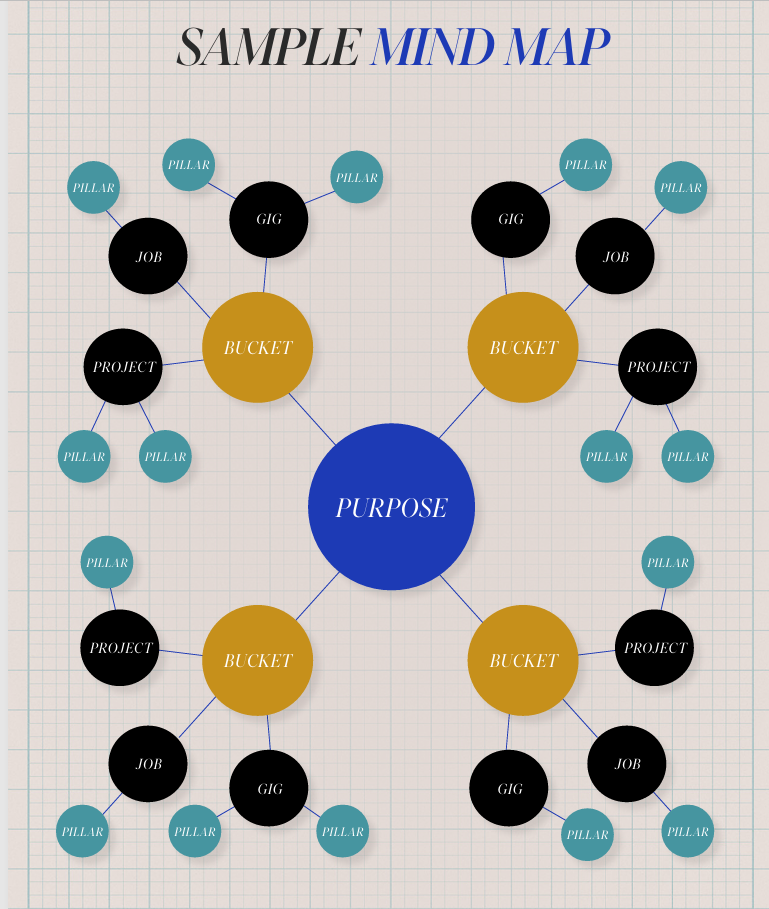
Former Teen Vogue editor in chief and multimedia icon Elaine Welteroth hosts an amazing Masterclass session on Designing your Career (Here’s a guest pass if you want to try Masterclass for a 14 day free trial). She shows how to harness your values, skills, and passions to create your dream career path. One of the tools she advocates using is a “Mind Map” that starts with your Why (Purpose) in the middle and then interests fan out from there.
The place to start is simpler than most people expect. You don’t need a big announcement or a formal program. You start by noticing where your interests already overlap with real needs around you and contributing there.
The question worth sitting with is not how to add more to your plate, but this: Where could you expand your contribution in a way that gives energy back, rather than taking more away?
That is where the next chapter begins. The goal isn’t to just build a career that looks good on a resume. Build one that actually feels good to live. I’m all for that!
Thanks for reading and sharing. xx




It feels like the way I’ve been living my life. There is a definite Purpose that drives everything I do with a variety of outlets to express it. Sometimes things can get out of balance, but having that purpose at your core brings you back to Center.
It’s like that weight at the bottom of an inflatable toy. It can get knocked around, but somehow it keeps standing back up.